
Liverpool as the ‘Second City of Informal Empire’: Blue Funnel and Shanghai, 1865-1914
2-3pm, Wednesday 18 November 2026 (by Zoom)
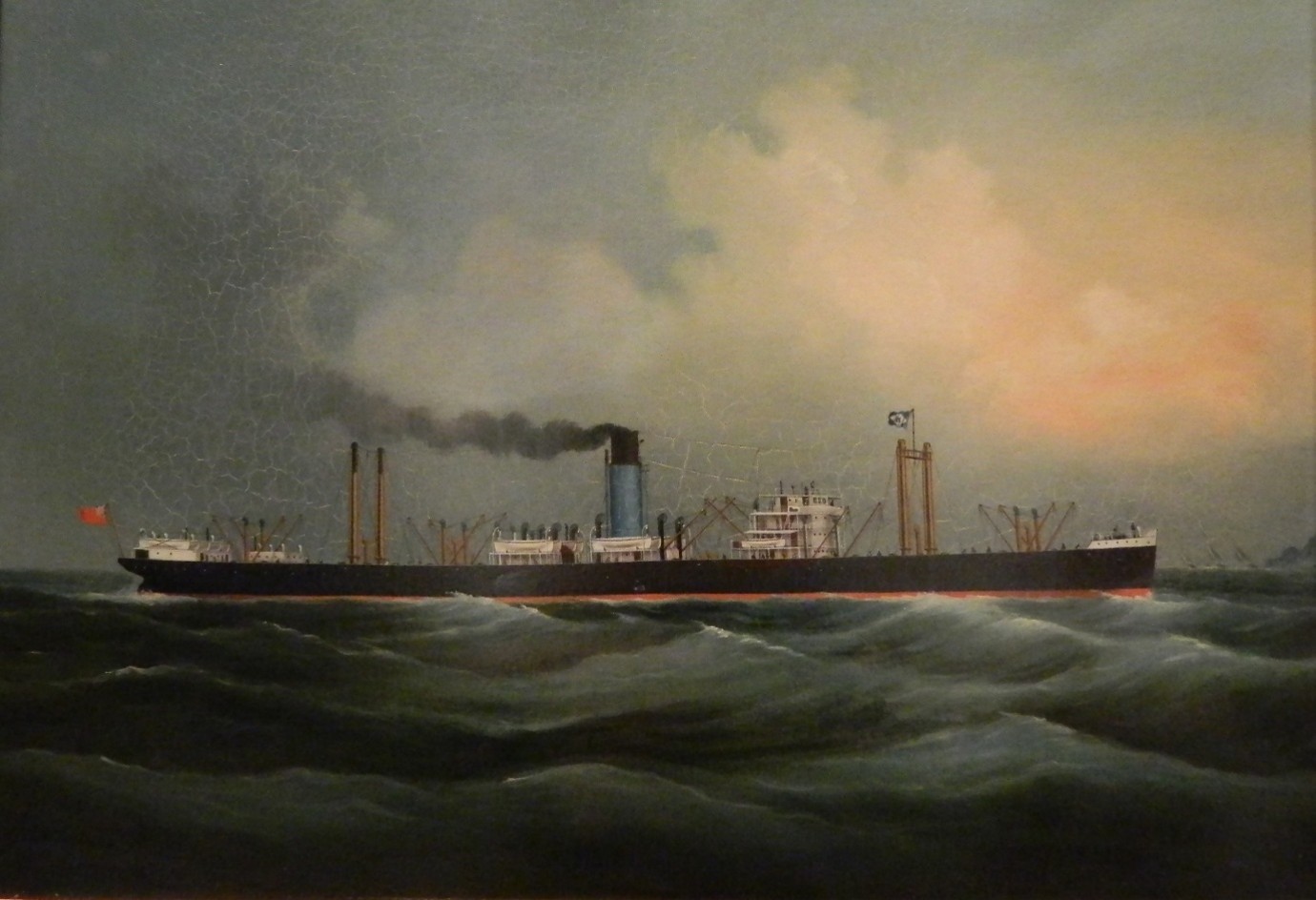
Painting of the 9,076 GRT Cyclops approaching Hong Kong. U-123 sank her in 1942 with the loss of 87 lives. The painting is in the Museum of Liverpool; the artist is unknown.
Seeking employment as a Ship’s Surgeon c.1905, Irish medic J.J. Abraham was advised to find ‘a ship bound East… and one belonging to a good company… Liverpool’s the place! London’s not in it with Liverpool when it comes to shipping!’ Abraham’s subsequent voyage, documented in his best-selling travelogue first published in 1911, was on SS Clytemnestra of Liverpool’s Blue Funnel Line (Ocean Steam Ship Company [OSSCo] or Alfred Holt & Company). Blue Funnel’s takeover of Glasgow-based and Manchester-linked China Mutual in 1902 confirmed the Liverpool line’s position as the UK’s leading cargo carrier to the ‘Far East’. Simultaneously, Blue Funnel was central to the growth of Liverpool’s Chinatown reckoned twice as large as London’s by the early-twentieth century. Pioneering direct steamship services from the UK to China, from its inception and first voyages (1865-6) much of Blue Funnel’s activity was concentrated on the premiere, British-dominated treaty-port of Shanghai. However, in examining seaborne ‘Informal Empire’ to the outbreak of World War One, this talk also recognises the limits of Liverpool’s influence. Blue Funnel’s reach was circumscribed by its ambiguous position betwixt industrial and financial capitalism, and strained relations with London powerbrokers. Moreover, by the end of the nineteenth century, Liverpool’s shipowner elite confronted uncertainty in China arising from internal instability and international commercial and power-political rivalry from which Shanghai was not immune.
Professor Nick White: A former president of the Historic Society of Lancashire and Cheshire, Nick White is Professor of Imperial & Commonwealth History at Liverpool John Moores University and Co-Director of Liverpool’s Centre for Port & Maritime History. His previous publications include The Empire in One City? Liverpool’s Inconvenient Imperial Past (Manchester, 2008) (ed. with Sheryllynne Haggerty and Anthony Webster). Inter alia, Nick is currently working on a study of Liverpool’s experience of decolonisation in the twentieth century.
Please email membership@hslc.org.uk for the Zoom link to this free online talk.